Ogbe Okanran: Meaning, Stories & Interpretation
Discover the meaning and interpretation of Ogbe Okanran (Ogbe Kanran) in Ifa Divination. Explore its themes of transformation, resilience, and the importance...
 olamilekan
10 min read
1,741 views
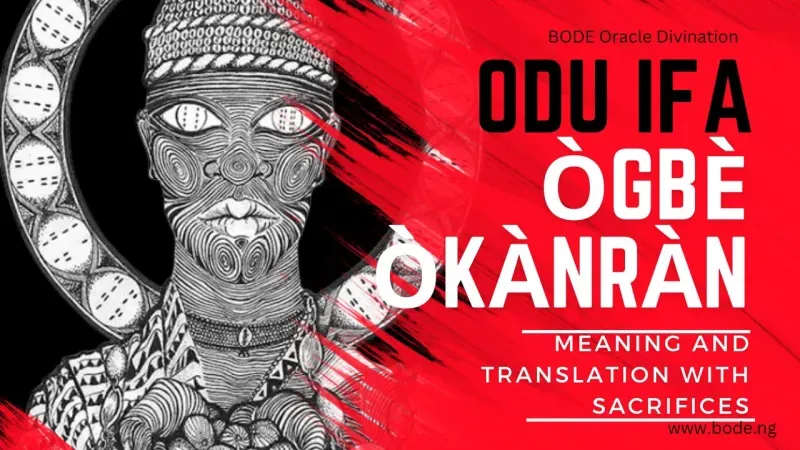
It recounts the historical struggles faced by the people of Ife and the divine guidance received through Ifa rituals. By embracing the teachings of Ogbe Okanran, individuals can overcome challenges, solidify their identities, and pave the way for prosperity and well-being in their lives.
Ogbe Okanran, Ogbe Kanran: Ifa Awuje
Ifa states that good fortune and blessings of children for the one who Ogbe Okanran was casted for, known as Ogbe Kanran.
Ifa says that an offering should be made. Ifa says that a journey is what one is currently preparing for; they should make offerings so that their intentions may prosper, and so that they may prosper with children.
Let us share food,
let us share trade.
This was the Ifa cast for Awuje,
Who is going to the farm of Alero with intentions that year.
It is said that the offerings will sustain us;
A lack of offerings cannot sustain a person.
Awuje, whom Ifa speaks of, does not have a child. She put two and three together, she went to the Ifa priest and ask Ifa, "How will I have children, and how will I go on this journey? Will my offerings sustain me there?.
They said she would have children there, and they told her to make offerings. She made the offerings, and it was not long before Awuje became very fruitful.
She came to thank the diviners, and the diviners of Ifa said, "Indeed, they said this:
Let us share food,
let us share trade.
This was the Ifa casted for Awuje,
Who is going to the farm of Alero with intentions that year.
It is said that the offerings will sustain us;
A lack of offerings cannot sustain a person.
It is not long; it is not far.
Come join us among the children, We will thrive among the children of Obaria.
Ogbe Okanran, Ogbe Kanran: Ifa Oro
Ifa states that it sees good fortune for the person that received Ogbe Kanran. Ifa declares that It will remove the individual from their adversaries. Ifa proclaims: "Ifa said this person will conquer all their enemies. Ifa advises that an offering should be made.
Otapetemoso
This was the Ifa cast for Oro.
The message that Ifa conveys regarding Oro, is that Oro was surrounded by adversaries who prevent Oro from recognizing the solutions to his challenges. They do not allow Oro to be at ease.
Oro contemplated deeply about what actions he could take until he found his way to the residence of an Ifa priest. They performed Ifa for him, revealing that the witches were hindering him, and that he should make offerings.
An offering of traditional palp with Ifa casted in it, the palp was mixed with abere and red pepper. Oro should drink and consume all these mixed elements.
Oro took the mixture, and once he did, the enemies could no longer approach him.
The essence of that day is the fangs of the Oro tree today. The pulp from that day became the vital essence that emerges from the Oro tree.
The spice of that day is what renders the Oro tree so lethal to the eye.
Ogbe Okanran, Ogbe Kanran: Ifa Olagbegi
The stone at the edge is a shield.
This was the Ifa cast for Olagbegi,
Who is going to Okiti Efon,
Who is going to meet them at the place of settlement.
Olagbegi is a person of significance. In his town, there are many adversaries due to his name.
This name is what people use to express their anger against him, claiming he has not yet arrived anywhere, and that he will become a great person in line with his name. The enemies do not allow him to rise. He pondered on what he could do.
When he combined two with three, he went to the abode of Ifa priest. They told him to leave this town, to go to another town, and to make offerings.
They said that once he made offerings, it would solidify his name, and that name would be what would elevate him to greatness.
Once he accomplished this and became great, he would eventually revert to his original name. When Olagbegi made offerings, he solidified his name.
When he arrived in another town, that is when he began to flourish. Everything of his prospered, and he became a great person.
He thanked the diviners, and the diviners thanked Ifa, Ifa thanked Eledumare, the King of Heaven.
When he reached the land of Okiti fon, they asked him, "What is your name?" He responded that his name is Olajuwere. They honored him with land and farmland. He then settled there. He was the one who remained a king in the land of Owo.
Olagbegi (the Olowo of Owo) remains the king of Owo town till today. Ifa declared that he would conquer all his enemies. Ifa advised that this person should make offerings and ensure to make substantial offerings as instructed by the diviners and heed to this sacrifice.
Ogbe Okanran, Ogbe Kanran: Ifa Ife Ooye Lagbemoro
Ifa states that the person who recceived Ogbe Okanran in divination should make offerings due to the misfortunes faced by this individual.
The transformation is the manifestation of the spirit.
The totality is the manifestation of the spirit.
This was the Ifa cast for Ogbe
On the day he went to confront death, misfortune, and distress, in Ife Ooye Lagbemoro.
In ancient times, the people of Ife faced many adversities, and they were in despair, the people of Ife asked a diviner to consult an oracle for them.
When they consulted Ifa, they invoked Ogbe-Kanran. Ifa instructed them to kill a big male goat, they should call upon the odus of ifa into it, and to go and knack it at the city's gates.
They should knack it to the large tree behind the city's wall. The people of Ife acted according to what Ifa instructed. From the day they made this offering, misfortune and untimely death, along with all other adversities, ceased to affect them.
They then reflected on what name they would call this Odu; they decided to name it Ogbe-Kanran because it represented the confrontation with death, misfortune, suffering, and distress in Ife Ooye Lagbemoro.
YORUBA Translation
Ogbe Okanran, Ogbe Kanran: Ifa Awuje
Ifa pe oun pe ire omo fun eni ti o da Ogbe OKanran ti a npe ni Ogbe-Kanran. Ifa pe ebo ni ki o ru. Ifa pe irin ajo kan ni eni nan fe lo, ki o ru'bo ki ibe le ba san an si owo, ki o san an si omo.
Ka bu'je, ka bu ta
A d'Ifa fun Awuje
Ti o nlo oko alero l'odun
O ni riru eb nii gbe ni
Airu kii gbe eniyan
Awuje ti Ifa nso yii oju omo npon ko ri omo bi. Lo ba mu eeji kun eeta, o lo oko awo wipe bawo ni oun yi oo se ri omo bi ati wipe oun fe rin irin ajo, nje ibe yi oo san oun ni o da Ifa si.
Won ni a a ri mo bi ni ibe, won ni ebo ni ki o ru. Won yan an l'ebo, o si ru eb naa. Ko pe ti Awuje di olomo pupo.
O wa nyin Awo, Awo nyin Ifa, o ni bee ni won wi:
Ka bu'je, ka bu ta
A d'Ifa fun Awuj
Ti o nlo oko alero l'odun
O ni ri'ru ebo nii gbe ni
Airu kii gbe eniyan
Ko pe o, ko jina
E wa ba wa laarin omo
Aarin omo laa ba ni lese Obarisa
Ogbe Okanran, Ogbe Kanran: Ifa Oro
Ifa pe oun pe ire isegun ota. Ifa pe oun yi oo yo o laarin ota. Ifa pe
oun yi oo je ki o ri ojutuu aye e re. Ifa pe ebo ni ki o ru.
Otapetemoso
A d'Ifa fun oro
Oro ti Ifa s'oro re yii, aarin ta eleye ni o wa de ibi wipe won ko je ki o ri ojutuu aye re. Won ko je ki o nilaari. Oro ro'nu titi wipe kini oun le se, loba ko'ri si ile alawo. Won da Ifa fun, woni ota eleye lo nba ja wipe ebo ni ki o ru.
Ki o ru eko fifo, ata pupa, abere lopolopo. Oro to'ju gbogbo nkan wonyi. Ni won ba ru'bo fun. Won se Ifa fun sinu eko fifo: won fa eko yii po mo abere, ni won ba ni ki Oro gbe eko naa mu.
Oro gbe eko naa mu. Bi o se mu u tan, awon eleye ko le de odo re mo. . abere ojo yen ni egun ti o wa ni ara oro di oni. Eko ojo naa ni o di oje ara re, ata ojo naa ni o wa lara oje re ti ko fi gbodo da si oju.
Bayii ni awon elye ko le de odo oro mo, ti oro si segun awon eleye patapata.
Ogbe Okanran, Ogbe Kanran: Ifa Olagbegi
Ido apata abidi jejere
A dIfa fun Olagbegi
Ti nlo Okiti Efon
Ti nlo ree ba won mile ibudo
Olagbegi yii eniyan ni. Ninu ilu re, awn ota po fun nitori Oruko re. Oruko yii ni awon eniyan fi nbinu re wipe koni tii de ibikan, ti yi oo fi di eni la gegebi oruko re, Awon ota ko jeki o dide. O wa ronu wipe kini oun le se.
Ni o ba mu eeji kun eeta lo lo oko awo. Won ni ki o kuro ninu ilu yii ki o lo si ilu miiran, ki o si ru'bo. Wipe ti o ba ti ru'bo, yi oo si pa oruko re da, oto ni oruko ti yi oo ma je ti yi oo fi di eni nla. Ti o ba ti ri se tan ti o di eni nla, yi oo wa ma pada je oruko re.
Ni Olagbegi ba ru'bo, o pa oruk re da. Igbati o de ilu miran, bayii ni o bere si ri se. ti gbogbo nkan re ndara, ti o si di eni nla.
O nyin Awo, Awo nyin Ifa, Ifa nyin Eledumare oba l'orun.
Nigbati o de ode Okiti Efon, won bi i leere pe. "kinni oruko re o?" O dahun wipe Olajuwere ni oruko oun je. Ni won ba bu ile ati ile oko fun. Lo ba te'lu do sibe naa. Oun lo wa ku ti nje oba ni ode Owo.
Olagbegi (Olowo of Owo) Ifa pe oun yi oo ba eni nan se'gun ota. Ifa pe ebo ni ki o ru, ki o si ma fi eti palaba bo ti awon awo ba ni ki o ru.
Ogbe Okanran, Ogbe Kanran: Ifa Ife Ooye Lagbemoro
Ifa pe eni ti a da Ogbe Okanran ki o ru'bo nitori ajogun ibi fun eleyiun.
Adan l'awo ara riri ra riri
Ogbigbi l'awo ara riri ra riri
A d'Ifa fun Ogbe
L'ojo ti o nlo ree kan iku, kan ofo, kan oran, ni Ife Ooye lagbemoro.
Ni aye atijo awon ara Ife ni awon ajogun po fun, ti won nda won laamu, ni awon ara Ife ba ranse pe Awo wipe ki o ba awon bere l'owo Ifa. Igbati won o da Ifa, won da Ogbe-Kanran.
Ifa ni ki won o pa oruko (obuko) nla kan, ki won o pe iye Ifa si, ki won o lo ree fi senu odi ilu. Ki won kan-an mo igi la l ehin odi ilu.
Ni awon ara Ife ba se ohun ti Ifa wi. Lati ojo ti won ti se irubo yii ni ofo, iku ojiji, pelu gbogbo ibi yooku ko ti sele si won mo, ni won ba e asaro wipe oruko wo ni won o ma pe Odu yi, won ni Ogbe-kanran ni toripe oun lo lo ree kan iku, to kan ofo, to kan iya, to kan oran n'Ife Ooye Lagbemoro.
No comments yet. Be the first to comment.