
Opon Ifa: The Ifa Divination Tray Explained
Opon Ifa serves as the divination tray for the babalawo, or Ifa priest, and is a crucial instrument used in traditional African and Afro-American religions...
 Adesola
5 min read
2,753 views
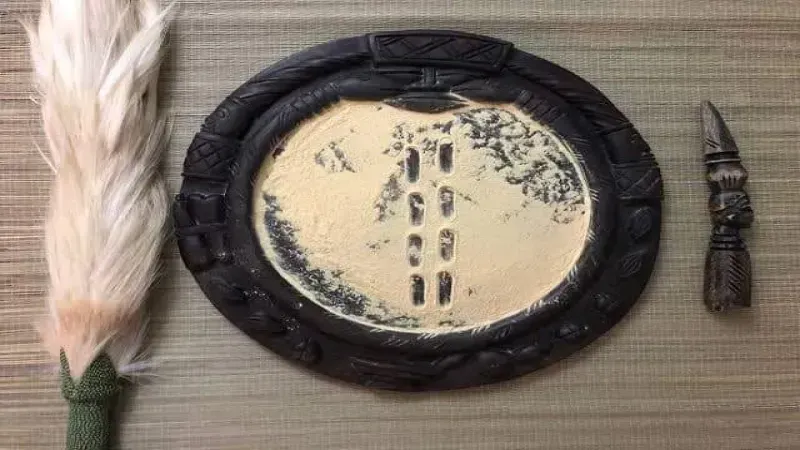
The opon varies in size and design, generally carved from wood and adorned with sacred symbols representative of Ifa cosmology. A prominent feature of the opon is the depiction of Esu, which adorns the upper quadrant of the tray.
The babalawo use the opon Ifa together with ikin, or sacred palm nuts, during divination. More significant than the tray's physical appearance is its metaphysical meaning.
The opon symbolizes the Universe, including both micro and macro aspects of existence. It is divided into four quadrants, each reflecting different facets of life.
In Yoruba tradition, when important issues arise or clarification is needed on significant decisions, individuals turn to the babalawo. Through the Ifa ritual, the babalawo sheds light on these matters.
Ifa is regarded as the most vital and reliable divination system, allowing individuals to discern the will of the Supreme Being, Olodumare (also known as Olorun or the Creator God).
Olodumare empowered Orunmila, the deity of divination, to pass the messages from the various Yoruba deities (orisha) during the divination ritual.
During a consultation, numerical patterns are generated by passing sixteen palm nuts between hands, recorded on the divination tray. Each pattern aligns with one of the 256 sacred verses that contain messages and the necessary sacrifices.
You Can Also Read More On
Relationship Between Ori Bibo And Ori
Brief History of Hermeneutics in Relation to Odu Ifa
The babalawo interprets these patterns using divination tools, including the opon Ifa, a tapper (iro Ifa), cups (agere Ifa) for the palm nuts, and a storage container for sacred materials (opon igede).
The opon Ifa is typically crafted in square, rectangular, or circular shapes. At the start of the ritual, the diviner taps the edge or center of the divination tray with an iro Ifa, or "tapper," to summon the attention of Orunmila, Esu, and other deities, as well as family ancestors and ancestral diviners.
While ordinary tappers are made of wood, successful diviners may possess tappers crafted from prestigious materials like copper alloy or ivory.
The king (oba) had exclusive rights to ivory, and only those granted permission could access this valuable material. The conical shape of the tapper indicates it was carved from an elephant tusk's tip.
In Yoruba thought, this cone represents life force (ashe), which energizes all things in the universe, making it a fitting form for an object used to invoke and honor the spiritual forces at play during a divination ritual.
During consultations, the opon Ifa allows the babalawo to communicate with Ifa, who identifies the roots and solutions to individual and communal challenges, restoring harmony with the spirits.
Esu, an intermediary orisha, acts as the messenger between the babalawo and Ifa, as the two are close companions. Once an odu is revealed by Ifa, the babalawo provides a solution embedded within the archetypal narrative of that specific odu.
Read More
Ori The Ifa Concept of Consciousness
Structural Design of Opon Ifa
Opon Ifa are wooden divination trays, typically ranging from 15 to 46 centimeters (6 to 18 inches) in diameter. They are generally flat and circular, though rectangular, semi-circular, and approximately square variations can also be found.
The trays feature a raised outer perimeter, often embellished with carved figures, objects, and intricate geometric designs. The structural design of the carvings serves as a status symbol among babalowos.
The top of the tray is known as the "head" or oju opon, while the bottom is referred to as the "feet" or ese opon. Typically, the head is adorned with a carved representation of Esu, the messenger of Ifa.
Some trays may feature multiple depictions of Esu, with variations showcasing two, four, eight, or even sixteen faces. In such cases, cowries may designate the "head" of the tray.
Cowries are also utilized to distribute the sacred divining powder, iyerosun. The carvings on the opon Ifa serve both functional and ornamental purposes, dividing the perimeter into nine sections, each carrying symbolic significance during consultations.
Each section is named after one of nine ancient and revered diviners. During a divination session, the babalowo positions themselves facing east with the opon Ifa before them, ensuring that the feet of the tray are closest to them.
In this orientation, the oju opon (the tray's face) is on the east, ese opon (the feet) on the west, ona kanran (the straight path) on the south, and ona murun (the direct path) on the north.
Additionally, four other sections or diviners are positioned diagonally: alaselosi ("the one who implements with the left") to the northeast, alabolotun ("the one who proposes with the right") to the southeast, afurukeresayo ("the one who possesses a diviner's fly-whisk and is joyful") to the northwest, and ajiletepowo ("the early riser who sits down and prospers") to the southwest.
People Also Read
Iwe Odu Ifa by Ifayemi Awopeju Bogunmbe
Odu Ifa Signs And How They Are Cast
Importance of Ifa Divination In The Practice Of Yoruba Traditional Religion
The central space of the tray, known as erilade opon ("the meeting place that crowns all"), completes the total of nine sections.
These sections become significant during consultations, as the babalowo calls upon the presence of Ifa and the nine ancient diviners before interpreting the tray.
The circumference of the opon Ifa may also feature carvings of animals significant in Yoruba mythology. Practitioners believe that these markings allow the babalowo to harness the powers of the represented animals, enhancing the tray's overall efficacy or amplifying the effectiveness of certain odu.
The symbolic meanings of the animals can sometimes be inferred from their roles in any of the 256 archetypal stories related to the odu.
For example, opon Ifa may display carvings of bush rats (okete), known in Yoruba mythology for their ability to take on human form for mischievous nighttime activities.
Birds, which often symbolize witchcraft, may also be depicted. Diviners from Oyo, Nigeria, assert that snakes symbolize the overall effectiveness of Ifa divination, as it is believed that snakes acquired their venomous properties from Ifa, as stated in the odu okaran asa.
Additionally, snakes may represent Ifa himself, explaining their frequent presence in opon Ifa and other forms of Yoruba art.
No comments yet. Be the first to comment.