
Children of Blood and Bone Ending Explained
The ending of Children of Blood and Bone changes everything for Orïsha. Here's what happens in the final chapters, what the cliffhanger means, and how it sets up Children of Virtue and Vengeance.
 olamilekan
4 min read
17 views
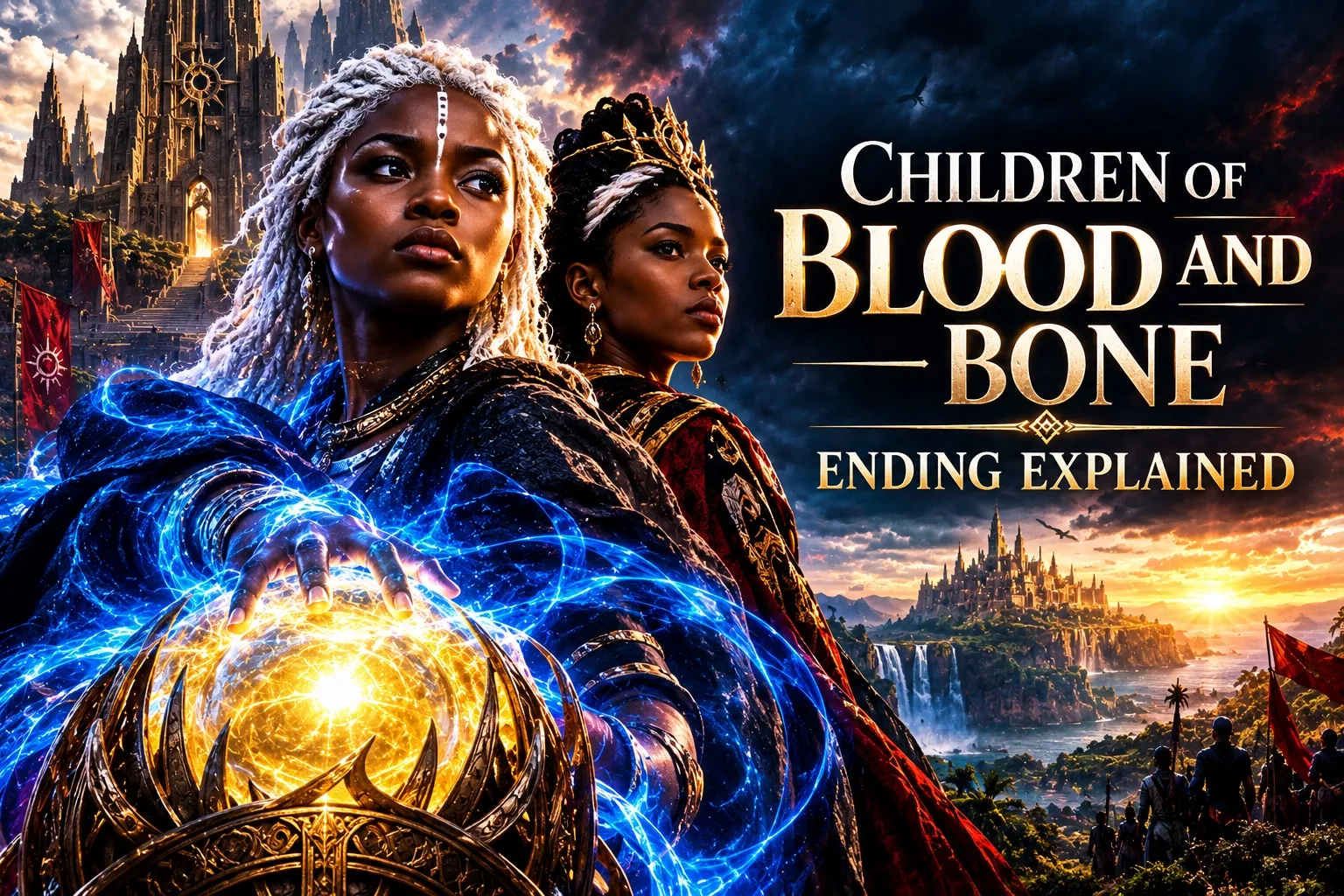
What Happens
The climax of the novel concerns the solstice ritual at the sacred island of Chândomblé. Zélie, Amari, and Tzain must complete the ritual using three sacred artefacts to connect the divîners to Nana Baruku — the primordial creator — and restore magic to Orïsha.
They reach the island. The ritual begins. But the cost of magic's restoration is not simple or clean.
Zélie discovers that restoring magic requires a sacrifice — and that the process of reconnecting Orïsha to the Orishas is not a clean restoration but a rupture, releasing forces that were suppressed for a decade with violent results.
Magic is restored. But not to the maji alone. The ritual resurrects something else as well: it also empowers the kosidáns — the non-magical ruling class — giving some of them magical abilities for the first time.
The playing field Zélie believed she was levelling has been tilted in a new and unexpected direction.
Inan's Choice
The novel's most emotionally resonant moment concerns Inan. He has fought against his own magic throughout the story, internalising his father's ideology. In the climax, he has the opportunity to stop the ritual. He does not take it.
His reasons are ambiguous, and Adeyemi keeps them that way deliberately. Whether he steps aside out of love for Zélie, out of his own suppressed recognition of what magic could mean, or out of something more complex — the novel offers a look rather than an explanation. It is one of the story's most honest moments.
His choice does not save him from his father. King Saran does not learn of his son's failure to act — not immediately. But the seeds of the conflict that drives the second book are planted in that moment of restraint.
Amari's Transformation
By the end of the novel, Amari has undergone the most complete transformation of any character. She began the story as a sheltered princess who had never fought anyone.
She ends it as someone who has killed in self-defence, crossed the kingdom with people who had every reason to distrust her, and chosen to stand with those who suffer under her father's rule rather than the father himself.
Her magical abilities have emerged. Her identity as heir to the throne has taken on a different meaning.
The Cliffhanger and What It Sets Up
The novel ends with magic restored to Orïsha, but restored in a way that immediately generates new conflict. The maji are no longer the only people with power.
The kosidáns who have gained abilities are, in many cases, people who have spent a decade persecuting magic users — and they now have magic themselves.
Children of Virtue and Vengeance (2019) begins in the immediate aftermath: a civil war brewing between newly empowered maji and newly empowered kosidáns, with Zélie and Amari on opposite sides of a fracture they helped create.
The restoration of magic did not bring peace. It brought a new phase of the same underlying conflict.
What the Ending Means Thematically
The ending resists easy triumph. Zélie achieves what she set out to achieve, and the achievement immediately reveals how complicated justice actually is.
Destroying an unjust system does not automatically produce a just one. Power distributed unevenly still produces oppression — it just changes who holds the rod.
This is Adeyemi's most ambitious idea, and the ending of the first novel plants it carefully. It is why the trilogy rewards reading through to the conclusion.
Frequently Asked Questions
Does magic get restored at the end of Children of Blood and Bone?
Yes. The ritual at Chândomblé succeeds and magic is returned to Orïsha — but with unexpected consequences.
What happens to Inan at the end?
He is present at the ritual and chooses not to stop it, though his exact motivations are left ambiguous. His relationship with Zélie remains unresolved, and the second book deals with the fallout of his choice.
No comments yet. Be the first to comment.